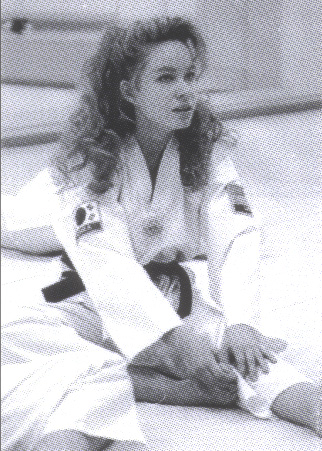
 Last year, when I was attending college up in Fremont, NE, I would drive back to Omaha to compete in Taekwondo tournaments almost every weekend with Grandmaster Shin and some other select students from his Academy. I guess I must have been on
a roll that semester, (much to Mr. Shin's delight) because I won first place in forms at every tournament. It felt great, but my victories were always somewhat dampened whenever I went back on campus the night after. There I was, usually at about 10 pm, lumbering back into my dorm, sporting the T-shirt of the tournament I had just survived, and hauling a 4-foot trophy on my arm. My fellow dorm-mates would often stop me in the hallway and say something like, "Wow, awesome! Who did you have to fight?" When I would politely correct them by saying it was a forms trophy, their faces would kind of fall. They seemed disappointed, sometimes confused.
Last year, when I was attending college up in Fremont, NE, I would drive back to Omaha to compete in Taekwondo tournaments almost every weekend with Grandmaster Shin and some other select students from his Academy. I guess I must have been on
a roll that semester, (much to Mr. Shin's delight) because I won first place in forms at every tournament. It felt great, but my victories were always somewhat dampened whenever I went back on campus the night after. There I was, usually at about 10 pm, lumbering back into my dorm, sporting the T-shirt of the tournament I had just survived, and hauling a 4-foot trophy on my arm. My fellow dorm-mates would often stop me in the hallway and say something like, "Wow, awesome! Who did you have to fight?" When I would politely correct them by saying it was a forms trophy, their faces would kind of fall. They seemed disappointed, sometimes confused.
I mean, sure, forms are beautiful to watch, but what else do they do? And what about other effective martial arts such as Mui Thai, Hapkido, or Ju-jitsu, which have no forms?
This reminded me of the silent debate in the martial arts community: Why do we have forms? What is their purpose? Do we really need them? Yes, just like high school kids complaining about the purpose of Algebra, martial artists are asking
the same thing about forms: When are we ever gonna use this in real life?"
Forms, also known as poomse or kata, were first created thousands of years ago by people who, ironically, were not artists, but warriors. And it's no surprise
that these men were more interested in the effectiveness and functionality of a fighting art than its artistic elements. So if these functionality-driven warriors were the creators of forms, it raises a good question: Did they know something we don't?
A good example of the advantages of practicing forms was set by Shogo Kuniba of Japan. A very talented and successful Japanese and Okinawan Karate practicioner, Kuniba found that his students, especially the beginners, were having a hard time
absorbing and learning the different techniques being taught in class. After some thought, he then went on to create 23 different forms which would incorporate 250 of the techniques in the art. As a result, his students made dramatic improvements in the comprehension and application of their technique. Why? The students claimed they could see how the techniques were performed; they had a better "feel" for them
as well.
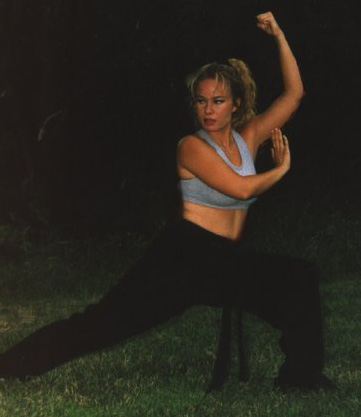 It also helps to pretend you're really fighting off a multitude of attackers, which helps you to master speed and power. I remember what my friend Matt did when he helped me perfect my blue belt form. He made up a little Jackie Chan-style martial arts comedy for me to think of as I went throught the techniques. "Okay," he'd say with that psychotic gleam in his eye, "This guy's comin' at you, he kicks low, you block it--BOOM! Then, he tries to hit high, so you do a combination open-hand rising block/kifehand strike to his neck!
Now kick him, he's down! Since he's lying helpless on the ground, you'll now have to leap over his broken body and land in a cat stance..." It made me laugh, but amazingly enough, it really gave me motivation and drive, which, in turn, dramatically enhanced my performance.
It also helps to pretend you're really fighting off a multitude of attackers, which helps you to master speed and power. I remember what my friend Matt did when he helped me perfect my blue belt form. He made up a little Jackie Chan-style martial arts comedy for me to think of as I went throught the techniques. "Okay," he'd say with that psychotic gleam in his eye, "This guy's comin' at you, he kicks low, you block it--BOOM! Then, he tries to hit high, so you do a combination open-hand rising block/kifehand strike to his neck!
Now kick him, he's down! Since he's lying helpless on the ground, you'll now have to leap over his broken body and land in a cat stance..." It made me laugh, but amazingly enough, it really gave me motivation and drive, which, in turn, dramatically enhanced my performance.
So while kata and poomse are generally used for competition purposes nowadays, their influence on the development of our internal power and fighting skills should not be overlooked. They are an essential part of the martial arts after all.
Now when I compete in tournaments and visions of evil masterminds and their private ninja armies are flying at me, I just have to try to find a way not to laugh.
Write to Christine at [email protected].
Return to Kicks Tae Kwon Do Training page.